Staff who reported working beyond regular hours
Particularly to address colleagues' needs
Royal College of Art · Generative AI Assistant Based on Company Work Data
Workmate.AI
Connected communication support, knowledge retrieval, and active task tracking in one assistant.
People spend about 30% of their lives working, while OECD research indicates that roughly 80% of workers experience mental stress.
People spend about 30% of their lives working, while OECD research indicates that roughly 80% of workers experience mental stress.
We found that excessive communication for task alignment pushes core work into overtime. Workmate.AI reduces the communication burden and provides a knowledge-search bot so employees have more equal access to company information and experience.
Context
Context & Background
Across four years, remote collaboration, more SaaS tools, and shorter delivery cycles multiplied the coordination work surrounding core tasks.
Most project information and decisions stayed within a smaller set of meetings and team tools.
Remote work increased online meetings, written updates, and the number of collaboration tools used every day.
Teams moved faster across more parallel projects, making work status and ownership harder to predict.
People spend more time finding context and aligning stakeholders, while core work is pushed beyond regular hours.
Context & Background · Survey and Interview
Particularly to address colleagues' needs
Updates and ownership were fragmented between channels
5 designers · 3 managers · 2 developers
User Research · Evidence
The mixed-role sample connected overtime to three recurring forms of invisible coordination work.
A product designer estimated that communication and alignment could consume up to 80% of the working day.
People repeatedly searched for helpful documents and colleagues because useful organizational knowledge was difficult to discover.
Managers and contributors lacked one reliable view of requests, dependencies, and overdue work across teams.
Frequent context switching and after-hours coordination increased stress and reduced time available for life outside work.
Context & Background
Role & Decisions
Ownership
User Research · Problem Statement
In a horizontally organized company, staff can spend 80% of their time on alignment communication.
Updates are repeated across tools, while reports still fail to reach the people who need them.
Working across several projects makes it difficult to see dependencies, priorities, and overdue work.
A limited internal network creates unequal access to useful documents, experts, and organizational experience.
Research & Strategy
Hypothesis · HMW Approach
“How might we enhance communication and alignment to help designers collaborate effectively, give them more time for core tasks, improve job satisfaction, and support work-life balance?”
Each research opportunity became a specific product capability, preserving the line from user evidence to design decision.
“How might we help people share an update with all relevant stakeholders without repeating the same coordination work?”
Starts conversations around urgent work, identifies relevant people, and suggests the next alignment action or meeting time.
“How might we reduce performance gaps caused by unequal access to documents, expertise, and organizational context?”
Retrieves trusted internal knowledge, finds relevant experts, and helps people access experience outside their personal network.
“How might we make task alignment compact, visible, and effective across several parallel projects?”
Organizes projects and requests, surfaces risk and overdue work, and prioritizes tasks by importance and dependency.
User Research · Persona
“Frequent minor adjustments and unproductive conflicts during negotiations prevent me from focusing on design tasks, making me worry about my career growth as a designer.”
Joey, 32, is a senior product designer at a global IT company. She wants to focus on high-value design decisions and grow her career, but meetings, fragmented resources, and repeated negotiations displace core work and extend the workday.
Her desired experience is predictable work, accessible organizational knowledge, and clear stakeholder alignment without relying on a large personal network.
Product & Delivery
Outcomes · Wireframe
An AI colleague that understands work history and stakeholder context, suggests relevant tasks like a teammate, and shares organizational knowledge like a manager.
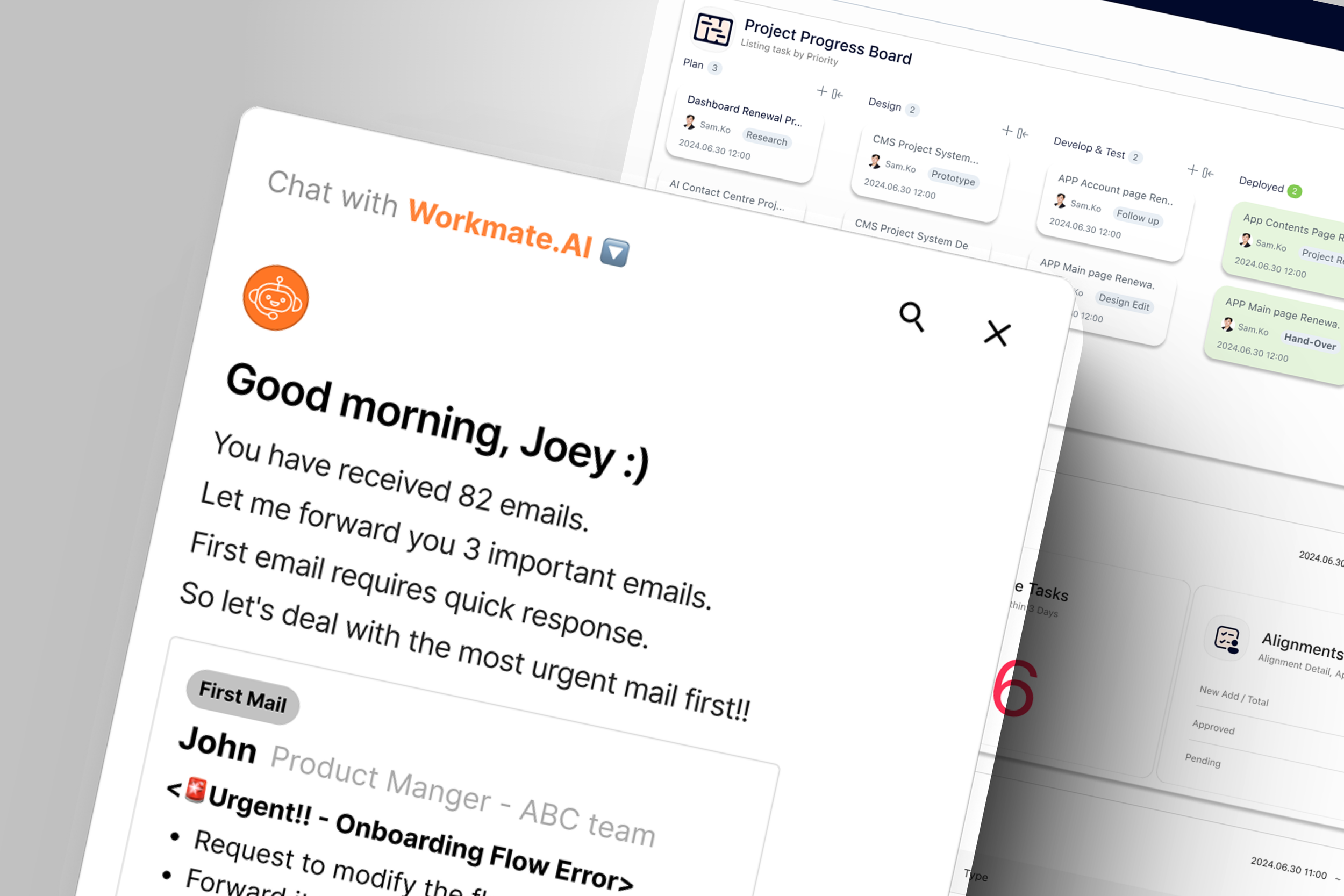
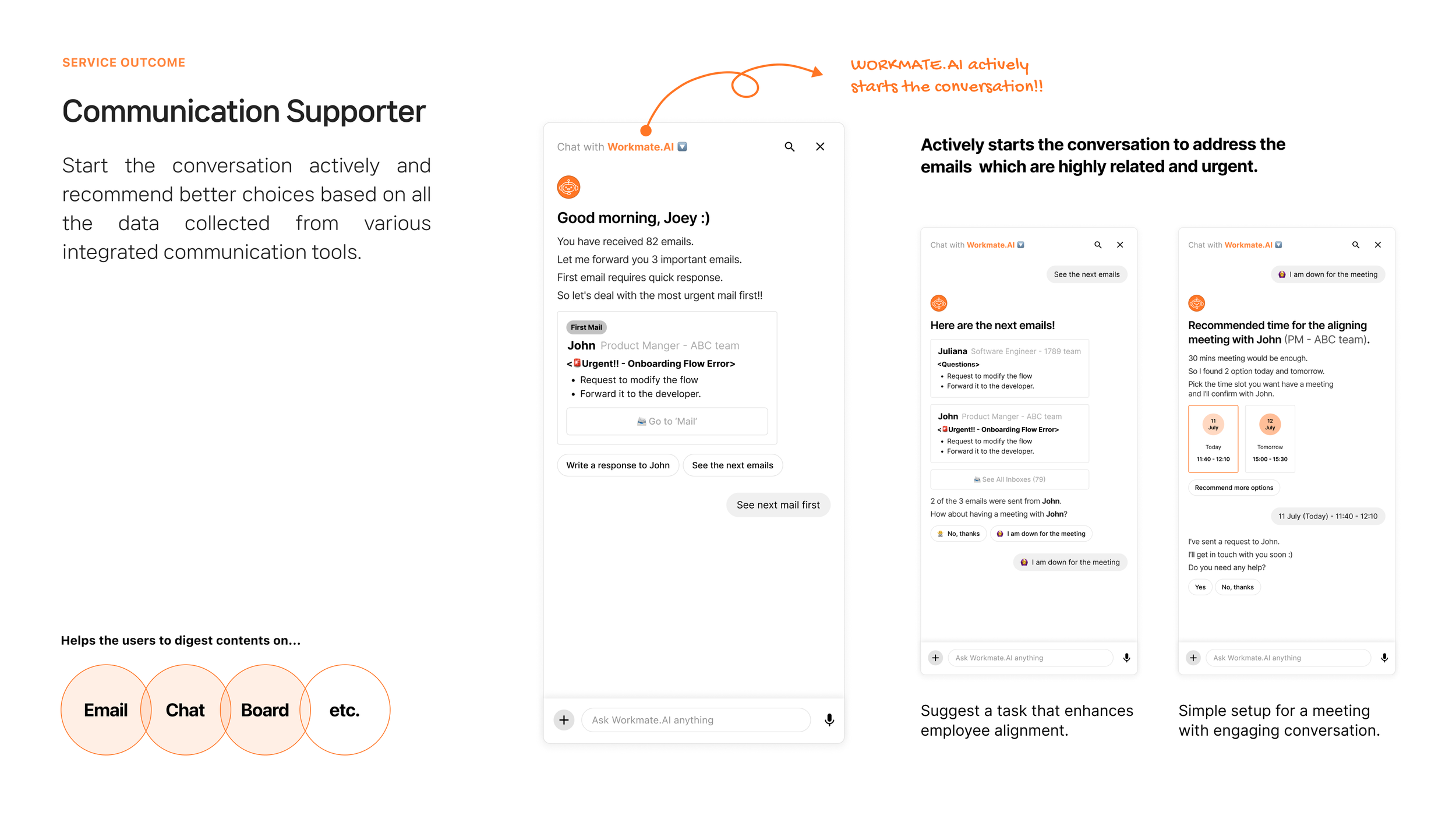
Starts conversations around urgent and relevant emails, suggests alignment tasks, and recommends available meeting times through a conversational workflow.
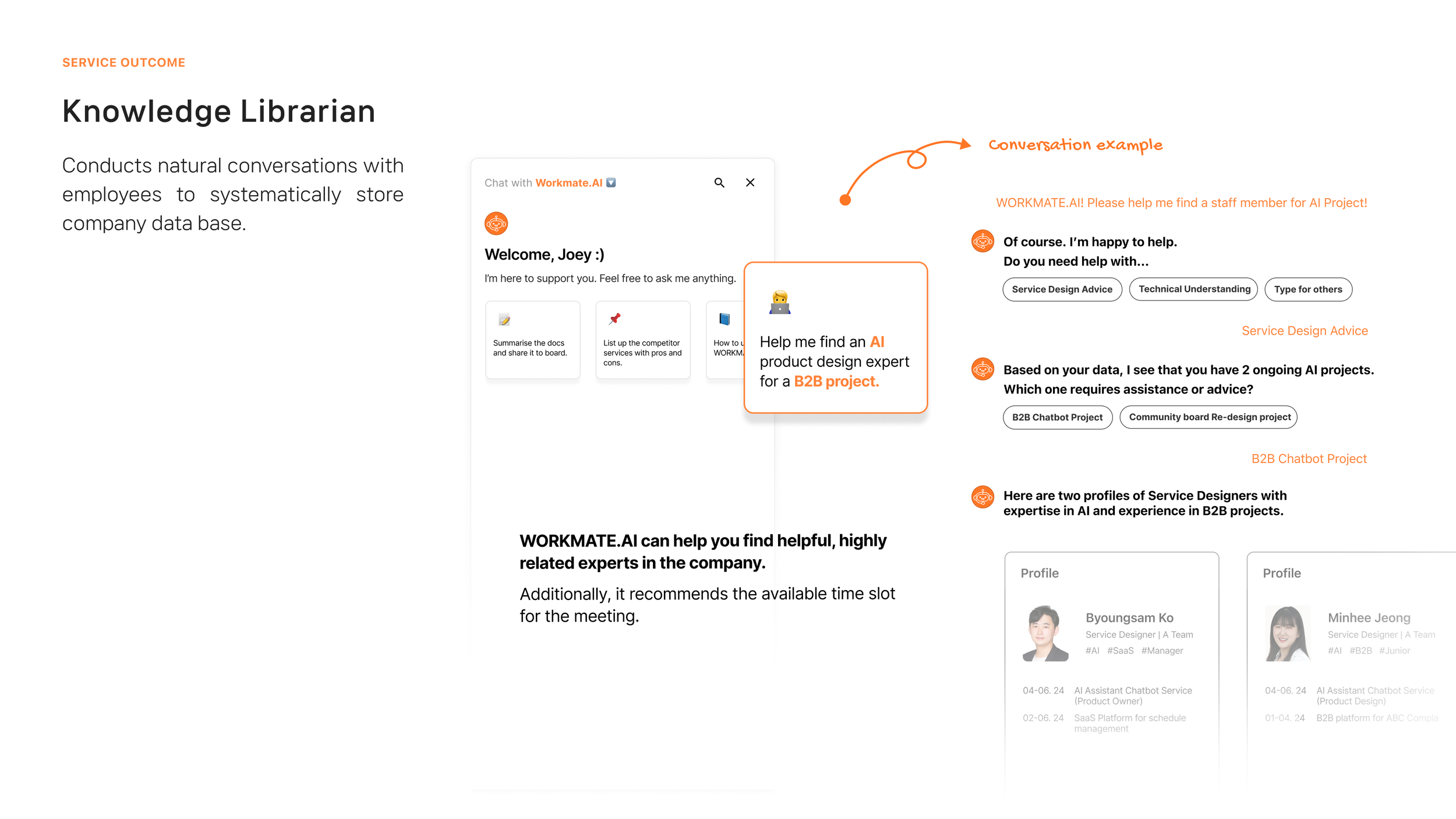
Uses natural conversation to organize company knowledge, find relevant internal experts, and recommend available meeting slots for a project.
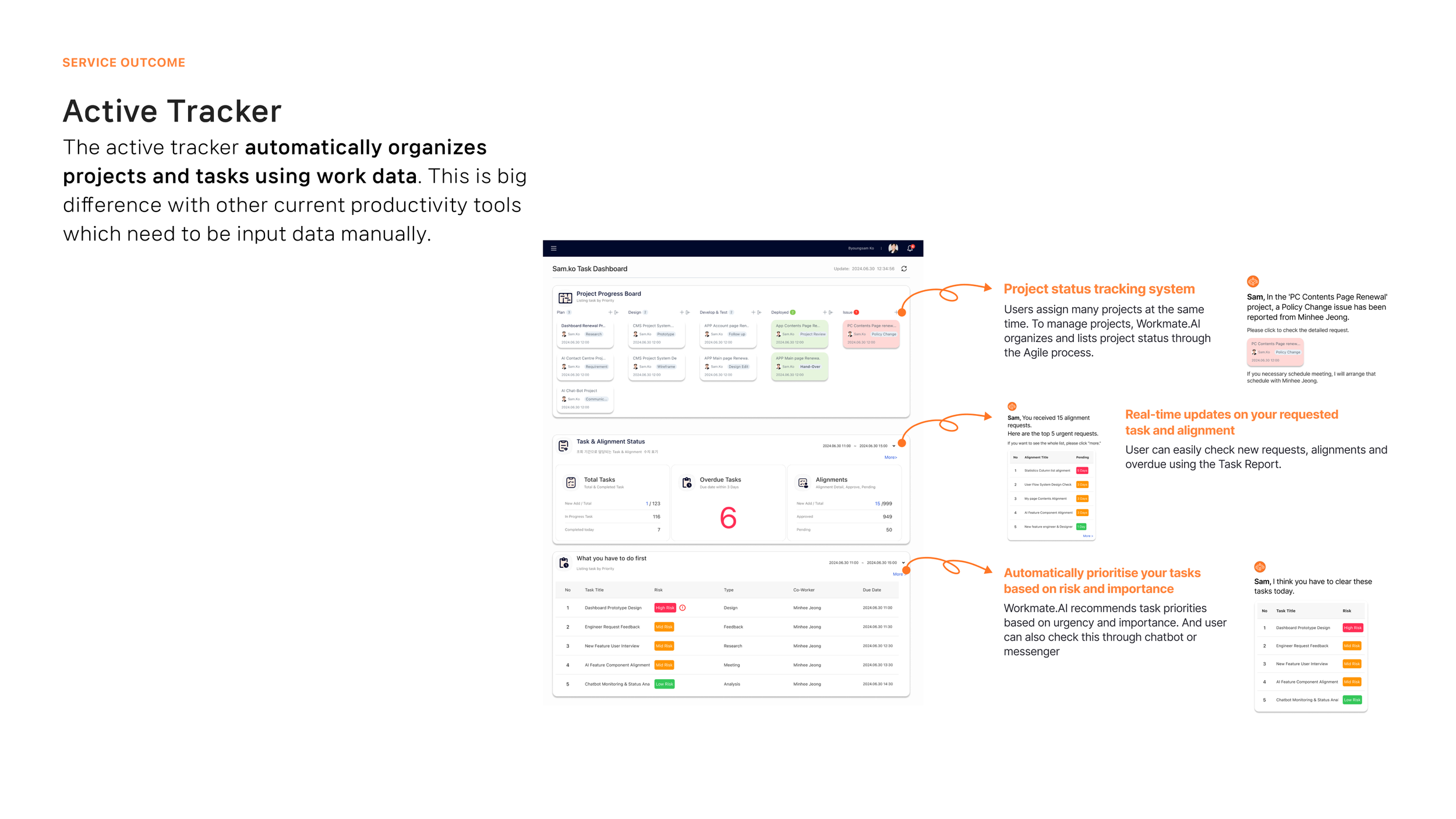
Automatically organizes projects and tasks from work data, surfaces requests, alignment, and overdue work in real time, and prioritizes tasks by risk and importance.
Outcomes · System Map
Authorized work data moves from connected business tools through a retrieval and governance layer before an AI model generates an answer or recommendation.
Demo Testing · Workmate.AI Knowledge Bot
We created a demo for the RCA service-design exhibition, where product designers gathered, using KakaoTalk as the channel and applying Communication Supporter and Knowledge Librarian UX components.
The demo stored service-design PDFs, team CVs, and schedules, used Elasticsearch BM25 to prioritize content, and called the GPT-4 API to generate answers grounded in retrieved content.
Outcomes · Demo Testing Insights
The public exhibition moved the concept beyond the original IT-company audience and made secure data connection the central product requirement.
Participants saw value for individual designers and workers in retail, finance, education, and other industries.
The service could support individual designers, not only large-company teams.
Users wanted an easy way to connect and protect work data before relying on AI recommendations.
Outcomes · Service Strategy
Workmate.AI should be approachable for individuals while remaining secure and operable for enterprise teams.
Impact
Outcomes · Our Next Step
What We Learned
Survey hypotheses became meaningful only after interviews revealed the context behind them.
The public exhibition brought feedback from people and industries outside the original scope, expanding the team's perspective.
A tangible demo produced real usability feedback that directly informed the service and business strategy.